Join us for the Smart Buildings Exchange 2026!

Smart Buildings Center

Energy Efficiency Innovation Center, Tool Library & Data Visualization

  • About
    • Staff
    • Board of Directors
    • Contact
    • Donate
  • Partners
    • Partner Benefits
  • Tool Library
    • Browse Inventory
    • Case Studies
    • Lending Library Policy
    • Customer Agreement
    • Tool Resources
  • Use Our Space
    • Training/Event Space
    • Large Conference Room
  • Training
    • Building Operator Certification
    • Remote Learning Calendar
    • Remote Learning Library
    • Qualified Energy Manager Training
  • Resources
    • Clean Buildings Performance Standard Helpdesk
    • Building Efficiency and CLean Operations Network (BEACON) Fellow Project
    • K-12 Ventilation & Indoor Air Quality Resources
  • Compliance
    • WA State Clean Buildings Performance Standard (CBPS)
    • City of Seattle Benchmarking Helpdesk
  • Events
    • SBX Conference
  • Blog

WSU Building HEROes Podcast

January 26, 2023 By SBC staff

Recently Melanie Danuser, Smart Buildings Center Director of Education & Training, and Rebecca Sheppard, Smart Buildings Center Senior Project Manager, sat down with the staff of the Washington State University Integrated Design + Construction Laboratory (ID+CL) to discuss the mission and vision of the mission division of Northwest Energy Efficiency Council, Smart Building Center programs and the Building Operator Certification trainings. ID+CL and NEEC are partnering with Northeastern University to develop and launch curriculum focused on grid interactive efficient buildings, and how to engage occupants as buildings get smarter. Listen here on apple podcast, the WSU website, or the embed below.

In many ways, a building’s efficiency relies heavily on the building operator. In this episode, WSU spends time with Melanie and Rebecca learning about the Northwest Energy Efficiency Council. They focus on improving the energy efficiency of buildings through training and resources for building operators in the PNW.

Filed Under: SBC News

2022: Year in Review

December 20, 2022 By SBC staff

2022 has been an exciting year at the Northwest Energy Efficiency Council (NEEC) and the Smart Buildings Center (SBC)! Over the course of the year, we saw an increased transition back from Covid isolation to a “new normal” or a new “normal for now.” We’ve seen more groups resume using our group conferencing spaces (the Training and Event Room and the Large Conference Room), to which we provide free access for the industry with a reservation via our online scheduling system. We added 35 tools to our Tool Lending Library, which continues to see robust usage, with over 500 free tool loans in 2022. The Smart Buildings Center held its first hybrid event with folks gathering on zoom and in-person at the Pacific Tower’s Panoramic Room for a discussion regarding how smart technology can support compliance with building performance standards. In the broader industry, there is a great deal of industry momentum with the passage of the Infrastructure Investment and Jobs Act (IIJA), the Inflation Reduction Act (IRA), and the shift to rulemakings and implementation on a large volume of state level and local policy. NEEC seized this moment to update our organizational mission to better articulate how the industry is evolving and what we’re all striving toward. Read on to hear more about our look back on 2022 and our look ahead to 2023.

Around the Region
In Washington, 2022 was another year of intense focus on clean buildings with the passage of an expanded building performance bill that extends performance standards to buildings over 20,000 square feet, updates to the state energy code, and with the continued work of the City of Seattle to develop its building performance standard, which will target greenhouse gas (GHG) emissions. In Oregon, where buildings have perhaps received less robust attention, the legislature launched the Resilient and Efficient Buildings Taskforce with members of the appointed group meeting to discuss the future of buildings in Oregon. Among other topics, the group evaluated a series of potential policies for their contribution to a range of goals including their ability to reduce GHG emissions. We are excited by the many policies they have considered and anticipate a centerpiece “buildings bill” in the 2023 legislature. We’re hopeful such a bill will include performance standards for buildings and have encouraged legislators to go in that direction. The Taskforce also considered the role that Energy Trust of Oregon (ETO) plays in the state and whether both ETO and energy efficiency goals more broadly should be aligned with climate goals. It should be an exciting session!

Smart Buildings Exchange (SBX)

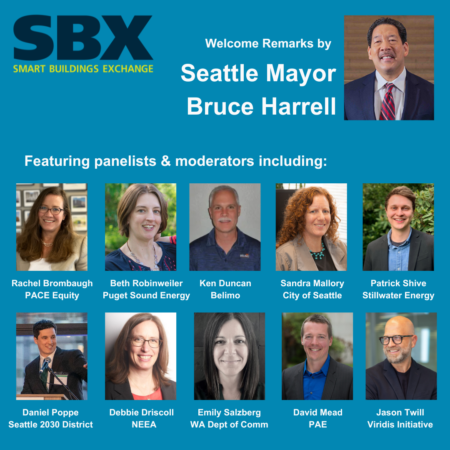
The SBC hosted its second annual Smart Buildings Exchange virtually and in-person August 22-24, 2022. Over 900 individuals from across the United States and around the globe engaged in a value-packed three days of conversations focused on the market opportunity for smart buildings and their role in our clean energy future. Session topics included the future of energy services and the built environment, grid-interactive efficient buildings, making existing buildings smarter, the role of smart buildings in reducing carbon, digital twins, and other compelling topics. The final day of the conference featured an in-person discussion on building performance data and how smart technologies can help building owners and managers in fulfilling requirements related to energy and ESG reporting. The session was also live streamed for virtual participation, and it was great to convene in a hybrid format for the first time in nearly three years! All SBX session recordings are available on the Smart Buildings Center YouTube Channel. Thank you to the speakers and event sponsors who made the conference possible!

Education & Training
In addition to bringing quick industry updates via our three blogs (NEEC, SBC and BOC), managing and administering the Building Operator Certification (BOC) Program, hosting countless webinars and events, recording new training videos for our YouTube channel, and hosting the Smart Buildings Exchange, the SBC launched a new service in 2022 to provide technical support to K-12 building operators, particularly in relation to indoor air quality. Through a grant from the State of Washington, the SBC created a virtual help desk and began adding and developing its resources. In addition to on demand video trainings and links to other materials, operators can submit online inquiries and reserve a one-on-one consultation with our dedicated Help Desk Manager, Rebecca Sheppard. Several new tools that can help address IAQ issues were also added to the Tool Lending Library.

NEEC continued offering BOC training in our region, totaling 17 courses. We trained over 400 students in NEEC territories alone, while training from our licensed partners reached O&M staff in 19 states. We also held our first pilot Multifamily BOC courses with a national reach and look to scale that program in 2023 to add it to our regular program offerings. Other news from the program includes the development and pilot of a class focused on Electrification and Building Operations in response to the growing push to decarbonize buildings, aligning with the recently announced renewed mission of NEEC.

Spring 2023 courses and the 2023 technical webinar series are open for registration at www.theboc.info/ — save your seats now!

New Faces
SBC welcomed Aeroseal as a new partner in 2022. Aeroseal is committed to making the world a better place by improving the air occupants breathe in buildings and reducing buildings’ energy usage at the same time. Aeroseal audits and tests buildings and then performs their innovative duct sealing technology that’s helped improve indoor air quality and occupant health and well-being in more than 150,000 projects nationwide. Learn more at www.aeroseal.com/.

NEEC welcomed the following new members in 2022: JCR Development and Alternative Utility Services, Inc.

On the staffing side, 2022 brought some changes to the NEEC family, as we added two new staff members — Rebecca Sheppard joined us in early 2022 as a technical subject matter expert on smart and efficient building operations. In her role, Rebecca manages several grants including one from the DOE to develop grid-interactive buildings curriculum for the BOC Program. And Jacob Hubbell joined this fall to serve in a variety of roles; first and foremost, joining our benchmarking team to support our staffing of the City of Seattle benchmarking helpdesk, a service NEEC has provided for over ten years via support from City Light and Puget Sound Energy.

Looking Ahead
Finally, and perhaps most significantly, the NEEC Board concluded its assessment of the energy efficiency industry to inform how the mission and strategy of NEEC should evolve. We were excited to conclude the initial process with the roll-out of a new mission—to eliminate carbon emissions from building energy use through market-based thought leadership, education, and advocacy. NEEC staff are now working with the Board to finalize our strategic plan with the development of objectives and strategies to support our mission. The new mission reflects the reality of the work our current and future members are doing, which combines energy efficiency with demand response, onsite renewables, battery storage and other technologies that support building flexibility and overall performance at the meter. We are eager to work with our membership to reform regulatory structures that inhibit the buildings transition, to foster the development of a competitive market for building performance and DERs, and to better articulate the building decarbonization and performance value proposition to building owners and managers.

Filed Under: SBC News

Smart Buildings Center DEI Initiative Update

October 31, 2022 By SBC staff

Over the past two years, the Smart Buildings Center (SBC) has been performing a Diversity, Equity & Inclusion (DEI) self-assessment to analyze SBC program reach, participation, and success rates in Washington State to establish baseline metrics and set goals for improvement. This work was born out of a discussion with the SBC Board of Directors about the need for a more critical examination of our work and the role we can and should play in supporting a more equitable community. The following provides an update on the self-assessment, which remains in process, and highlights some initial steps the SBC has taken to leverage opportunities to promote equity. Once the self-assessment is complete, SBC will develop a DEI action plan with annual reporting to the Board of Directors on progress.

As an initial step of the self-assessment, SBC worked with the Pacific Northwest National Laboratory (PNNL) through technical assistance provided by the U.S. Department of Energy’s Better Buildings Workforce Accelerator to develop a replicable and scalable dashboard that analyzes BOC Program participant diversity, and systemic barriers to success amongst specific groups, to provide staff with a baseline on current program participant diversity that can be leveraged to set goals and track improvement over time. PNNL produced two reports detailing the development of the dashboard and the analysis results which are summarized and linked below. The BOC Program, which trains building operators and facility staff in efficient building management, reaches a population that spans forty states. Staff started the self-assessment with the BOC Program because it is our largest program and consequently provided a substantial opportunity for impact. While the program spans forty states, this initial analysis was conducted on the Washington State program; we hope to expand this work more broadly in the future.

The analysis included 1,658 Washington State BOC training and certification candidates over a ten-year period (2010-2020) and utilized self-reported zip codes (home or work) in conjunction with U.S. Census, U.S. Environmental Protection Agency, and Washington State demographic, socioeconomic, and environmental health data to draw conclusions. Because gender was the only demographic indicator available for some candidates and a work address rather than a home address was only available for other candidates, the results are not 100% accurate, but show important trends and opportunities for improvement. It is also important to note that participant location (home or work) does not necessarily mean participants are members of represented demographic and socioeconomic groups.

Most BOC program participants included in the analysis are from the Seattle-Tacoma area with clusters of participants from other large and mid-sized cities such as Wenatchee, Yakima, Tri-Cities, and Spokane. The majority of BOC certification program participants were male (52%), followed by female (24%) with the remaining 24% not specifying a gender. Fifteen percent of certification program participants identified as military veterans but only one identified as a female veteran. The sectors with the greatest representation were Property Management (23%), City/County Government (17%), Healthcare (13%), Other (9%), College/University (6%), Utility (6%), Hospitality (5%) and State Government (3%). Participants are skewed towards communities with higher than average (state-level) education and lower percentages of residents who are linguistically isolated. Participants are more likely to come from counties that are predominantly White and non-Hispanic and experience lower levels of poverty. Women are also underrepresented in the BOC training program and the disparity increases from BOC Level I, where 11.82% of participants are women, to Level II, where 8.95% of participants are women.

The analysis identified opportunities across a range of areas including:

  • Opportunities to expand outreach and participation in rural communities, including agricultural areas in central and southeastern Washington
  • Opportunities to expand outreach and participation from underserved census tracts in urban areas or in areas bordering large cities including South Puget Sound, some areas north of Seattle such as Northgate, Everett, and Fairmont, the Spokane Valley, and North Spokane
  • A need for additional research to identify strategies and support pathways for expanding opportunities for women in facilities maintenance, operation and management

In addition to examining the SBC’s Building Operator Certification (BOC) program, staff have also examined data from the annual Smart Buildings Exchange conference and will soon conduct a DEI survey to gather and analyze data from SBC staff, the Board of Directors, SBC partners, Northwest Energy Efficiency Council (NEEC) members, BOC instructors, BOC graduates, SBC event speakers, and Tool Lending Library members. While we intend to use this analysis to form an action plan and to establish thoughtful, meaningful objectives and strategies that stem from that analysis, we also saw an immediate opportunity to expand diversity in our partnerships by offering a complimentary Women-Minority-Owned-Business-Enterprise (WMBE) SBC Partnership Level. At this level, partners can promote their businesses with logo placement in all places where partner logos are included and receive a featured blog post to further spread awareness of their products and services.

If you would like to learn more about SBC’s DEI efforts, including our complimentary WMBE SBC Partnership Level, upcoming DEI survey, and expanded outreach efforts, please contact Britton Rife.

BOC Training Program Analysis Report
BOC Certification Program Analysis Report

Filed Under: SBC News

The Essential Role of Smarter Buildings in the Clean Energy Transition

October 31, 2022 By SBC staff

Increasingly, across the United States and abroad, building owners are implementing comprehensive Environmental, Social and Governance (ESG) programs. ESG programs provide a framework for assessing and managing risks stemming from a range of environmental, social and governance factors. This trend is fueled in part by an increasing understanding of the looming danger of climate change across a range of potential outcomes from financial risk to human health and wellbeing. In many jurisdictions, the push for ESG reporting is also coming from the regulations that are being imposed on buildings, largely driven by the urgency around climate mitigation actions. It is widely accepted that climate warming stops when Greenhouse Gas emissions stop. In the US and elsewhere, this is leading policymakers to focus on greenhouse gas mitigation through regulation of emissions. By far, the two largest sources of emissions in the United States are transportation and buildings. If we are to stop or even slow climate change, we need to lower emissions from cars and buildings.

Policies aimed at buildings take two different approaches. The first is to target buildings directly through regulation of building site emissions, such as the forthcoming commercial building performance standard from the City of Seattle. The second approach targets the energy system that provides buildings with electricity, space and water heating. Policies aimed at decarbonizing the energy system ultimately affect the availability and pricing of electricity and other energy fuels, and often come in the form of policies that regulate power sources. In Washington State, the legislature passed the Clean Energy Transformation Act, which seeks to eliminate carbon from electricity requiring electric utilities to shift to carbon free power sources. Given this plan to decarbonize electricity in Washington State, the state energy strategy recommends an overall electrification pathway (for buildings and transportation alike) as the least cost pathway to meeting the state’s greenhouse gas emissions targets. The authors of the strategy point out that such a pathway will increase the electrical load by roughly 92% over the 2020 level. You hear similar estimates from other states and even national calculations. In the climate space, there is widespread agreement that to stop climate change, we need to achieve net zero carbon emissions by 2050 and that “clean electricity” fueling our buildings and transportation is essential to success, but it will require a groundswell of innovation and new technologies to get there.

What does this mean for buildings? What role do smart buildings play in the clean energy transition? Will this all amount to increased costs in building ownership or are there financial benefits and opportunities for building owners who convert to smart technologies to support the transition? At the Smart Buildings Center (SBC), these are questions we have been asking industry leaders and will continue to explore in our programming. We believe smart buildings have an essential role to play in the transition to a carbon free economy and we believe there is great economic potential for building owners who lead this transition with grid-interactive technologies, systems that align with grid needs and clean power production, onsite battery storage, onsite EV charging and innovations around how those technologies are leveraged, and more smart technologies, approaches, and practices that will recruit high tenancy and support the social and economic goals of the community in which they reside.

We plan to continue to push these discussions through the SBC programming, stay tuned for more to come along these lines, and in the meantime, check out the recordings from some of the discussions that have already taken place—and don’t miss this blog post from our partner organization, NEEC.

2020

  • Smart Buildings Week – Grid-Enabled Efficient Buildings

2021

  • Smart Buildings Exchange 2021 – Opening Plenary Panel – Smarter Buildings and a Changing Utility – a Vision of the New World of Energy
  • Smart Buildings Exchange 2021 – Grid-Interactive Efficient Buildings
  • Smart Buildings Exchange 2021 – Buildings and Carbon
  • Smart Buildings Exchange 2021 – Deriving Value from Smart, Interactive Buildings

2022

  • SBC Executive Forum – Electrification & Grid-Interactive Efficient Buildings, part 1
  • SBC Executive Forum – Electrification & Grid-Interactive Efficient Buildings, part 2
  • Smart Buildings Exchange 2022 – Senior Executives Discuss the Future of Energy Services and the Built Environment
  • Smart Buildings Exchange 2022 – Building Performance Reporting – How Smart Technology Can Help
  • Smart Buildings Exchange 2022 – Grid-Interactive Efficient Buildings
  • Smart Buildings Exchange 2022 – the Role of Smart Buildings in Reducing Carbon Emissions

Filed Under: SBC News

Seattle 2030 District 2022 Energy Competition

September 29, 2022 By SBC staff

Seattle 2030 District is hosting its 2022 Energy Competition that will offer viable energy saving solutions to an affordable housing building that will serve as a model for the clean energy future through exemplary building performance. The competition is underway and the winner will be announced in November – December, however, they are still accepting teams if you’re interested in getting involved.

Learn more here!

Filed Under: SBC News

SBC Welcomes New Partner: Aeroseal!

September 22, 2022 By SBC staff


The Smart Buildings Center is excited to welcome Aeroseal as a new Smart Buildings Center Education Program Partner!

Aeroseal’s beginning dates back to 1993 when Dr. Mark Modera invented a breakthrough aerosol-based sealing technology that made it possible to seal leaks and holes in air ducts from the inside out. Dr. Modera then teamed up with Amit Gupta, a heating and air industry leader, and they’ve since been committed to making the world a better place by improving the air occupants breathe in buildings and reducing buildings’ energy usage at the same time.

Aeroseal audits and tests buildings and then performs their innovative duct sealing technology that’s helped improve indoor air quality and occupant health and well-being in more than 150,000 projects nationwide. Their solution has helped clients in the Healthcare,  Hospitality,  Education, and CRE sectors improve indoor air quality while reducing energy usage and costs.

Learn more by downloading Aeroseal’s Commercial Solutions brochure and watching their Mission & Purpose video

Filed Under: SBC News

Posts pagination

Previous Page 1 … Page 12 Page 13 Page 14 Page 15 Page 16 … Page 43 Next

Help fund our Education Program

DONATE TODAY

Sign up for updates

Join the Smart Buildings Center mailing list for information about events and smart buildings news.

Your email has been added to the Smart Buildings Center mailing list for information about events and smart building news.

News & Articles

Last Call for Call for Speakers! SBX 2026 Call for Speakers Deadline is Friday 7/17

July 15, 2026

SBX 2026: Keynote Announcement, Call for Speakers & Early-Bird Deadline

July 13, 2026

WA Commerce: District energy campus upgrades committee update

July 13, 2026

Smart Buildings Center Q2 Quarterly Recap

July 10, 2026

AESP Announces Nerdy Energy Bar Talk

July 9, 2026

Contact Us

Smart Buildings Center
Pacific Tower
1200 12th Ave. S., Suite 110
Seattle, WA 98144

206-538-0832

[email protected]

Smart Buildings Center is a project collaboration with Building Potential


Smart Buildings Center · Pacific Tower, 1200 12th Ave. S., Suite 110, Seattle, WA 98144 · 206-538-0832

© 2026 · Northwest Energy Efficiency Council