SBC Lend & Learn Workshop
Last month the Smart Buildings Center (SBC) along with local businesses and professionals working within the clean building environment, came together for two in-depth workshops. The goal of these workshops was to create a pilot program that would help grow local manufacturer’s clean technologies, expand the SBC’s Tool Lending Library (TLL), and find the best ways to get these tools to users looking to reduce energy and carbon emissions in their buildings. Currently the TLL consists of over 950 tools including 85 unique types. Tools can be rented out locally for up to four weeks in Washington and Oregon. Users can go to the Smart Building Center’s website to reserve tools from the library and pick them up in person, or have them shipped to their location.
Industry leaders from across Washington and Oregon were represented in the workshops including King County’s rail and solid waste divisions, South Seattle College, Energy 350, Washington State Department of Commerce, Shoreline Public Schools, and Seattle City Light.
Inside the workshops, groups discussed how more manufacturers and tool borrows could be reached; and the value proposition of the pilot between the two. Feedback highlighted the need for getting the tools to people who normally wouldn’t have access to them, more training sessions of tools inside the lending library, and better ways to get them deployed into the field. The groups also worked on finding ways to work with local organizations in creating learning programs centered on attracting people looking to get into clean energy.
SBC sent out a survey in March asking TLL users why they use the library and how it helps them achieve their energy goals. Results from the survey came back with 93% citing how free access to tools and overall inventory depth supported them on new projects. Workshop participants spent time breaking down the survey results trying to find the best ways to expand library inventory while paying special attention to local manufactures and small business users. Providing future trainings, webinars, and access to volunteers within the clean energy sector were also discussed.
In both workshops participants were challenged to put the pilot program into action and build upon what is already in place. Not only getting cutting edge tools into peoples’ hands, but also the newest software that is currently being used in the market today. Local manufacturers shared their thoughts on optimal ways to get the tools they produce out to the public while receiving the feedback and success stories they need to improve their products. SBC discussed possible website updates where individual case studies could be posted and users could share their experiences and results that they achieved.
One of the many workshop activities was working on the role of diversity and inclusion in the pilot program. Considerations included how to reach more women and people of color, not only through the TLL, but also by bringing more representation when it comes to what start-ups, existing small businesses, and trainers in clean technology solutions are hosted at the library. Everyone worked on figuring out how to create more meeting spaces for collaboration and getting the word out to these specific communities.
Going forward, SBC will continue working with current TLL users, clean technology solution providers, and local municipalities and schools to expand the reach of the TLL. New tool manufacturers and interested tool borrowers across all demographics will continue to be sought after to share their ideas and expertise on what clean energy projects are being targeted for commercial buildings.
Click here to download a detailed report on these workshops.
This blog was written by Michael Oliver, SBC intern with the South Seattle College Sustainable Building Science Technology Program.
To learn more about the TLL or how to become an SBC partner, please visit www.smartbuildingscenter.org.
SBX Opening Plenary Session: Smarter Buildings & a Changing Utility – A Vision of the New World of Energy
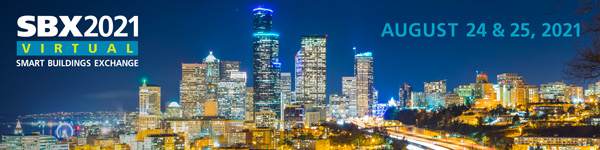
The agenda for the free virtual Smart Buildings Exchange to be held August 24th and 25th is nearly finalized! The event will dive deep into the role of smarter buildings in a changing energy landscape through interactive conference sessions on grid-interactive efficient buildings, workforce development to meet the needs of the smart, clean and efficient buildings industry, and the business case for smart building investments.
Opening Plenary Session: Smarter Buildings and a Changing Utility – A Vision of the New World of Energy
The conference will kick-off on August 24th with a moderated discussion featuring senior thought leaders in the technology and utility sectors. Panelists include Mary Kipp, CEO of Puget Sound Energy, Debra Smith, CEO of Seattle City Light, Ed Schlect, CSO of Avista Utilities, Stephanie Greene of the Rocky Mountain Institute, and Emmanuel Daniel of Microsoft. Moderated by Ash Awad, President and Chief Markets Officer of McKinstry, this panel will discuss the opportunities and challenges facing the energy industry and how that affects the built environment. A new, cleaner, and more flexible electrical grid is coming. These changes will be facilitated in part by smart building technologies and practices built on the fast-growing power of cloud computing and information technology services. This is sure to be an exciting and informative discussion which will frame issues getting discussed throughout the subsequent two days of the conference.
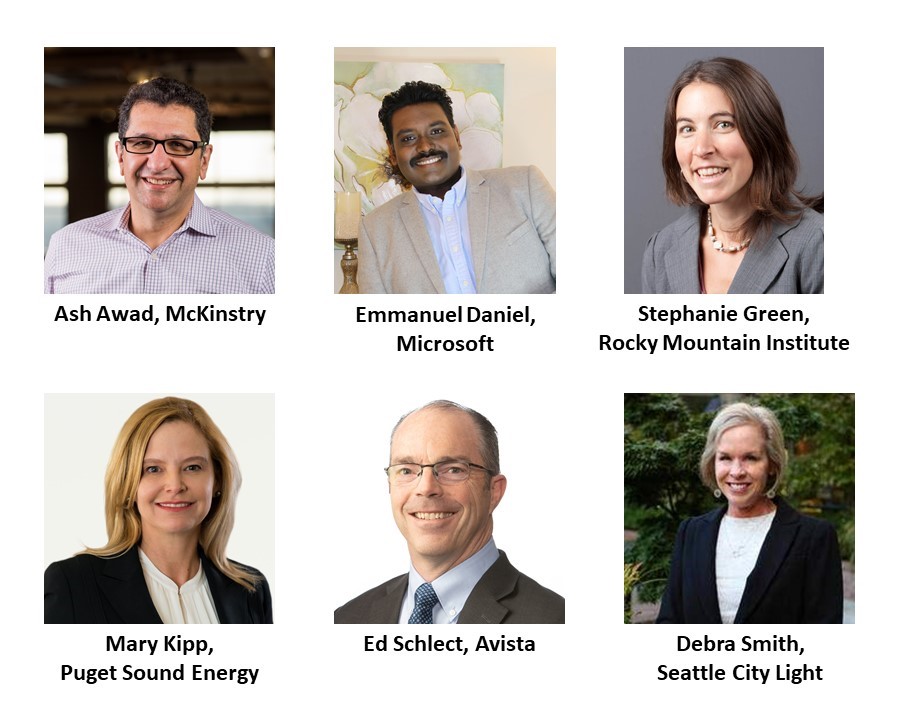
View speaker bios
View the full conference agenda and register for free today!
Check Out Our New Tool Library Video Tutorials – on the SBC YouTube Channel!
With support from Puget Sound Energy, Seattle City Light, and Washington State Department of Commerce, the Smart Buildings Center (SBC) has developed a new video training series demonstrating practical applications of some of the tools available in SBC’s Tool Lending Library for providing healthier air while maintaining energy-efficiency. These topics are especially relevant to occupying buildings during and post-pandemic. Videos in the series include:
- Healthier Air in Buildings: Tools and Strategies
This video gives an overview of the tools available for testing air flow, pressure, and CO2 levels in relation to preventing the spread of airborne infectious disease, increasing occupant comfort, and maintaining energy-efficient HVAC systems. - Verifying Ventilation System Effectiveness Using a Flow Hood
This video demonstrates how to use a flow hood to test air velocity going through a grill to determine the ventilation system effectiveness, in this case for restroom exhaust. Calculating air changes per hour is also discussed. - Assessing Air Pressure in Buildings
This video demonstrates how to use a digital pressure gauge and/or air flow meter to determine zonal or building pressure relative to another zone or to the outdoors. - CO2 Measurement for Healthier Air in Buildings
In this video, we discuss the use of CO2 monitoring and data logging equipment to help approximate how well a space is being ventilated with fresh air over time, including a demonstration of graphed data analysis.
These tools and many more are available for short term rental – (for free!) at the Smart Buildings Center website. Follow us on our YouTube Channel for additional video tutorials and other smart buildings content!
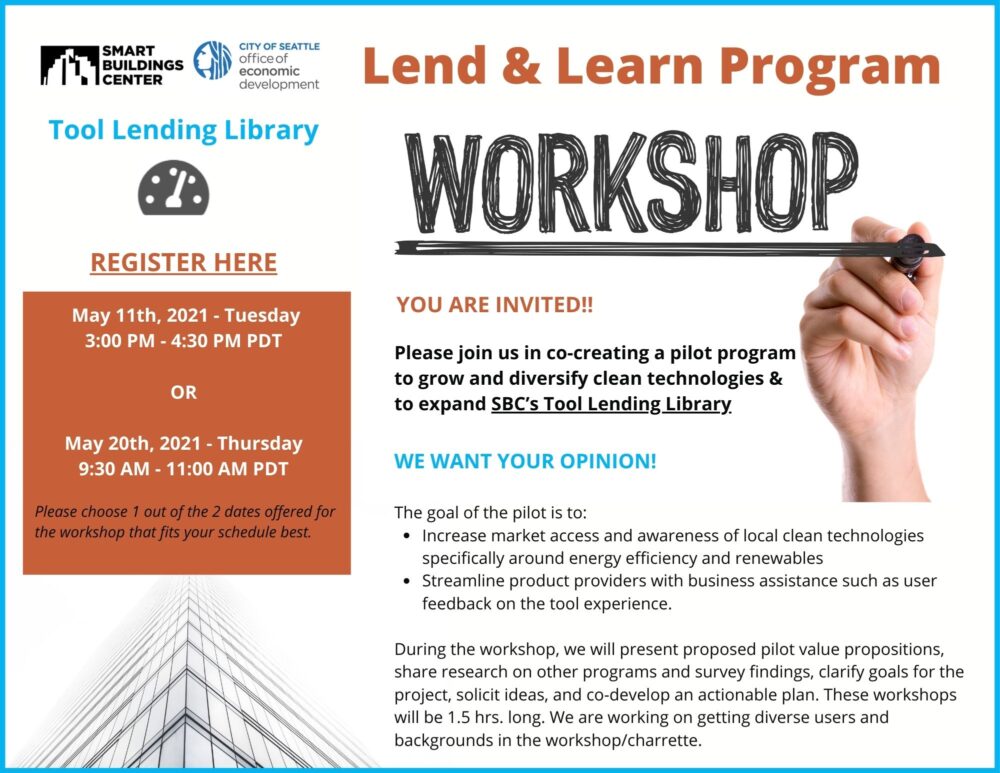
Join us for an SBC Lend & Learn Workshop!
BOC Scholarship Opportunity — Deadline Extended!

Scholarship available: This scholarship was created by Grosvenor Americas, a privately-owned property group that has a strong commitment to sustainability and wishes to help promote green practices within the building operations industry.
One scholarship is available to a prospective Building Operator Certification (BOC) student in Washington in 2021. The scholarship amount is $2,180 and is to be spent on the BOC training and certification program. ($1,895 towards training and certificate completion, $285 towards certification examination). This scholarship is intended for a prospective BOC student who is currently unemployed.
Eligibility for the BOC program is two or more years of experience working in operations and maintenance of a commercial or institutional facility, or a minimum of one year of experience working in operations and maintenance of a commercial or institutional facility paired with at least one year of technical college level education in facilities engineering related program, or two or more years of experience in energy management of facilities with a focus on operations and maintenance.
Applications should be completed by April 20th and submitted to [email protected]. Questions can be directed to Britton via email or phone 206-588-4984.
Application
- Name:
- Are you currently a WA state resident? (y/n)
- Are you currently unemployed? (y/n)
- If yes, where was your last employment (company & title):
- If no, current employer/title:
- Please write a brief description of your experience in the operations field and reason for wanting to attend BOC training (please limit to 500 words)