Join us for the Smart Buildings Exchange 2026!

Smart Buildings Center

Energy Efficiency Innovation Center, Tool Library & Data Visualization

  • About
    • Staff
    • Board of Directors
    • Contact
    • Donate
  • Partners
    • Partner Benefits
  • Tool Library
    • Browse Inventory
    • Case Studies
    • Lending Library Policy
    • Customer Agreement
    • Tool Resources
  • Use Our Space
    • Training/Event Space
    • Large Conference Room
  • Training
    • Building Operator Certification
    • Remote Learning Calendar
    • Remote Learning Library
    • Qualified Energy Manager Training
  • Resources
    • Clean Buildings Performance Standard Helpdesk
    • Building Efficiency and Clean Operations Network (BEACON) Fellow Project
    • K-12 Ventilation & Indoor Air Quality Resources
  • Compliance
    • WA State Clean Buildings Performance Standard (CBPS)
    • City of Seattle Benchmarking Helpdesk
  • Events
    • SBX Conference
  • Blog

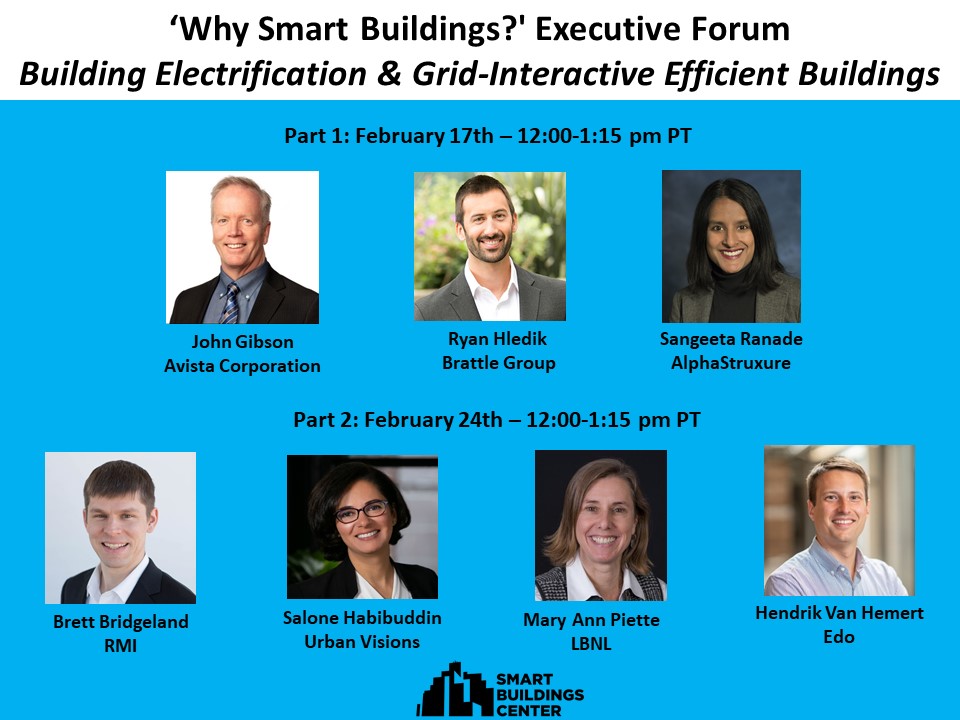
ā€˜Why Smart Buildings?’ Executive Forum

January 13, 2022 By SBC staff

Building Electrification & Grid-Interactive Efficient Buildings

Thursday, February 17th & 24th
12:00 – 1:15 pm PT
Register Here!

Certainly, increasing building electrification (BE) is a critical step toward decarbonization of the built environment. The specific steps to achieve BE are somewhat less certain. Replacing carbon-emitting fossil fuel appliances with clean electric sources is the easy answer, but as usual there are lots of complexities in making this happen in both commercial and residential buildings – new and existing. During the Smart Buildings Exchange (SBX) 2021 virtual conference, two technical sessions on grid-interactive efficient buildings (GEBs) highlighted the potential values of deploying dynamic two-way communication capacity in buildings to both the electric utility system and building owners and managers. This two-way communication can automate load shifting, shedding, and modulating and improve a utility’s capacity, resiliency, and cost. Building on the SBX 2021 conversations, this two-part Executive Forum discussion will link the efforts around BE to successful widespread deployment of GEBs.

Part 1 of this series will bring together expertise from the policy, regulatory, ratemaking, and utility industries to discuss their view on what must change from current practice to ignite a robust market for GEBs. Like most SBC events, this Executive Forum will be structured as an extemporaneous discussion between panelists (with a twist – see note on format below). Sure to be a dynamic and engaging discussion, this panel will tackle issues such as:

  • Building electrification – the role that GEBs need to play to allow for optimizing utility capacity management/coincident peak management (the context being, can building electrification succeed without some form of GEBs)
  • Grid modernization – everyone agrees that it needs to happen and that it will be expensive. Do GEBs offer a least cost approach to modernization that will enhance reliability/resilience?
  • Are GEBs a complement to the Northwest’s emerging energy imbalance market – are the two compatible?
  • Why aren’t GEBs evaluated as a resource in the 8th Power Plan?
  • Are GEBs more realistic/helpful to the utility system in the residential or the C/I sector?
  • What scale is necessary for GEBs to be a real solution?
  • What rate reforms are needed to make GEBs work?
  • What policy/regulatory reforms are needed to make GEBs work?

Part 2 of this series will feature a panel drawn from the communities of building owner/manager, developer, service provider and research institutions to discuss the market side of this equation. Of course, there has to be a market-based value proposition for the BE-GEBs solution to decarbonization and this group will take that question head-on. Again, expect a dynamic conversation amongst the panel addressing core issues, such as:

  • Who is responsible for triggering market adoption – utility-customer-third party-government/regulator?
  • Will dynamic rate structures be sufficient to move the market or are some types of financial incentives also needed?
  • Are GEBs only realistic for new construction?
  • If the future of commercial buildings is variable occupancy does this help or hurt GEBs deployment?
  • How critical is the inevitability of EV charging to GEBs?

This FREE two-part virtual series is targeted to building owners/managers, developers, utilities, service providers as well as those with interest in or responsibilities for policy and regulatory changes related to decarbonization.

Ever been frustrated that your question didn’t get addressed by a panel because they ran out of time? Submit your questions ahead of time during registration and we will tailor the conversation to match your information needs!

Register Here!


Filed Under: 'Why Smart?' Events, Webinars

Strategic Energy Management in Higher Education Facilities: COVID and Beyond

January 10, 2022 By SBC staff

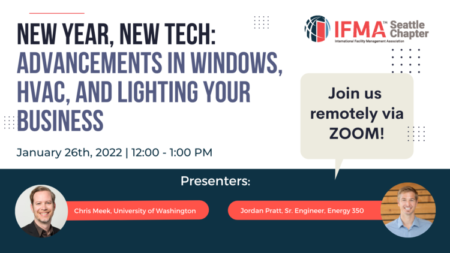
January 26, 2022
1-2 pm PT
REGISTER

Smart Buildings Center is excited to announce the next event in our ongoing series of Commercial Strategic Energy Management (CSEM) webinars, produced in partnership with Puget Sound Energy.

In this interactive webinar, panelists with expertise in strategic energy management (SEM) in higher education facilities will discuss their lessons learned in navigating the challenges of operating their buildings safely during the COVID-19 pandemic. They’ll also share insights for moving forward with a re-focus on energy efficiency, in light of the challenges presented by climate change and resulting mandates such as the WA Clean Buildings Performance Standard (H.B. 1257).

Register in advance for this webinar. After registering, you will receive a confirmation email containing information about joining the webinar.

Filed Under: Education & Training, Webinars

Understanding the WA Clean Buildings Standard

January 10, 2022 By SBC staff

The Clean Buildings Standard is one measure Washington State is taking to improve building operational efficiency. Propelling buildings to targeted energy use intensity by building type and size, all commercial buildings over 50,000 sf will need to comply by 2028 (220,000 sf by 2026), and then maintain compliance or be subject to penalties.

UMC, Hargis Engineers, and the Northwest Energy Efficiency Council (NEEC) have joined forces to break down the Clean Buildings Standard’s Ā options and implications so you can define a path forward that aligns with your portfolio. [AIA CEU HSW 1.5 Credit]

More information on the presentation

REGISTER

Filed Under: Education & Training, Webinars

Webinar: Meeting Water & Energy-Saving Goals in King County

January 4, 2022 By SBC staff

Sustainable Energy Solutions & Innovative Financing Options

January 25, 2022
10:00 – 11:00 AM PT
REGISTER

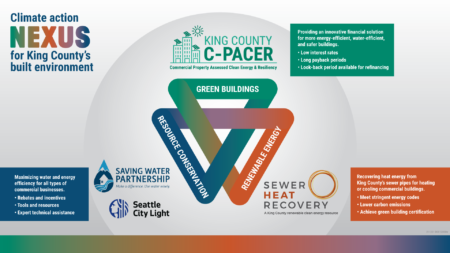
The Northwest Energy Efficiency Council and Smart Buildings Center invite King County building owners, managers, financers, and decision makers to attend and hear from King County, Seattle Public Utilities, and Seattle City Light representatives about sustainable energy solutions and innovative financing options to help you meet your water and energy-saving goals.

Webinar speakers and topics will include:

Morgan Torres, Executive Climate and Energy Program Manager – Office of the King County Executive
King County will share its new innovative financing program, C-PACER, explaining how it can be used to invest in efficiency and resiliency measures to make buildings safer, more efficient, and less expensive to operate.

Natasha Bailey, Commercial Water Conservation Program Manager – Saving Water Partnership
The Saving Water Partnership is an organization comprised of 19 water utilities in King and Snohomish counties. We offer tips, tools, and rebates to help people preserve our region’s water for future generations.

Erika Kinno, Resource Recovery Research & Policy Project Manager – King County Wastewater Treatment Division
King County makes its sewer pipes available to private commercial property owners to use as a heat energy source for buildings. Sewer heat recovery can help lower energy costs, save water, and boost renewable energy use. The C-PACER program and Saving Water Partnership rebates are great opportunities that could support the use of this technology.

Register to join us on January 25th!

Filed Under: Education & Training, Resources, Webinars

Upcoming Lighting Design Lab Courses

January 4, 2022 By SBC staff

Commercial HPWH: Engineering Deep Dive Part 1
Tue, Jan 11 | 10am-noon | FREE
DAY 1 of 2. This course provides a foundation for implementing commercial heat pump water heater systems in multifamily settings.
REGISTER

Commercial HPWH: Engineering Deep Dive Part 2
Tue, Jan 18 | 10am-noon | FREE
DAY 2 of 2. This course provides a foundation for implementing commercial heat pump water heater systems in multifamily settings.
REGISTER

Tools for Modeling the 2018 SEC and WSEC
Thu, Jan 20 | 10am-11:30am | FREE
This course highlights the energy modeling requirements for Seattle and Washington State 2018 energy code compliance as well as ASHRAE 90.1 Appendix G – the new modeling standard.
REGISTER

Commercial HPWH: Design, Operations & Maintenance Deep Dive Part 1
Tue, Jan 25 | 10am-noon | FREE
DAY 1 of 4. Energy efficient commercial HPWH systems for the multifamily and commercial sector are gaining traction. This session dives deep into the science, technology, design and implementation of successful CHPWH systems.
REGISTER

Commercial HPWH: Design, Operations & Maintenance Deep Dive Part 2
Tue, Feb 01 | 10am-noon | FREE
DAY 2 of 4.Ā Energy efficient commercial HPWH systems for the multifamily and commercial sector are gaining traction. This session dives deep into the science, technology, design and implementation of successful CHPWH systems.
REGISTER

Commercial HPWH: Design, Operations & Maintenance Deep Dive Part 3
Tue, Feb 08 | 10am-noon | FREE
DAY 3 of 4.Ā Energy efficient commercial HPWH systems for the multifamily and commercial sector are gaining traction. This session dives deep into the science, technology, design and implementation of successful CHPWH systems.
REGISTER

Commercial HPWH: Design, Operations & Maintenance Deep Dive Part 4
Tue, Feb 15 | 10am-noon | FREE
DAY 4 of 4. Energy efficient commercial HPWH systems for the multifamily and commercial sector are gaining traction. This session dives deep into the science, technology, design and implementation of successful CHPWH systems.
REGISTER

Introduction to Central Systems for Heat Pump Water Heating (Part 1): The Whys and Hows of Heat Pump Water Heater Systems for Multifamily and Commercial Applications
Tue, Feb 22 | 10am-11am | FREE
DAY 1 of 2.Ā This course will explore the policy drivers that are pushing the integration of central heat pump water heating systems and highlight the economic, energy, and environmental advantages of heat pump water heater systems for commercial and multifamily projects. It will also discuss successful projects and case studies, while outlining which applications have the best opportunities for success.
REGISTER

Introduction to Central Systems for Heat Pump Water Heating (Part 2): How to Select and Design a Heat Pump Water Heater System in Your Next Multifamily or Commercial Project
Tue, Mar 01 | 10am-11am | FREE
DAY 2 of 2.Ā This course provides an overview of key central system design considerations. It explores the different system components, including next generation refrigerants, and gives an update on the status and evolution of available plug-n-play commercial equipment. Lastly, it walks through the Ecosizer tool available to properly size central heat pump systems.
REGISTER

Filed Under: Education & Training, Webinars

2021: Year in Review

December 27, 2021 By SBC staff

Northwest Energy Efficiency Council (NEEC) Advocacy 2021
In 2021, we continued to see our daily lives impacted by the ongoing presence of Covid 19. Both Oregon and Washington legislatures met in a virtual format, which some might say enabled greater constituent and stakeholder participation and certainly did not generate barriers for our engagement. NEEC participated in both sessions delivering constructive feedback and testimony to legislators and collaborating with peer advocates to identify where our voice might be needed. In Washington, we supported the Climate Commitment Act where we collaborated with several NEEC members to deliver testimony and provided our voice to the education campaign led by Clean and Prosperous Washington. In Oregon, we supported HB 2021, which requires electric utilities to achieve 100% clean electricity by 2040, delivering constructive testimony to legislators to encourage they consider the demand-side opportunities alongside and equally with the supply-side opportunities. Both bills were passed and NEEC will stay engaged as rulemakings determine how these laws are implemented.

Both Oregon and Washington are undergoing rapid change in the energy space with the recent passage of 100% Clean, Clean Buildings and others. Statewide and local policy are impacting our industry at an exhilarating pace from sweeping legislation like cap and trade to smaller city ordinances and energy codes such as the recently announced Executive Order from Mayor Durkan of the City of Seattle, which calls for the formation of a carbon-based commercial building performance standard. As both states look to decarbonize buildings and electricity, it is essential that we consider the structural and regulatory barriers in place to smart and innovative ways to leverage buildings in the clean energy transition. NEEC believes that while decarbonizing electricity is an important goal, it cannot be reasonably achieved without also considering how we can shape consumer energy loads to better align with when renewable energy sources are producing power. Policies that encourage utilities to procure demand-side building-as-grid resources provide those utilities with more options in how they decarbonize the grid. In having more options, utilities can manage their service in the most efficient and affordable manner. At the same time, these policies will help to usher in an era of building innovation that will accelerate smart buildings technology adoption and expand regional economic development. We look forward to continuing to partner with all of you to champion smart policy that supports a priority role for buildings in the emerging clean energy landscape.

New NEEC Members
NEEC welcomed the following new members in 2021:

New Smart Buildings Center Education Program (SBCEP) Partner

SBCEP welcomed Seattle Public Utilities Saving Water Partnership as a new partner in 2021. The Saving Water Partnership is an organization comprised of 19 water utilities in King and Snohomish counties that share a common water supply. They offer tips, tools, and rebates to help people preserve our region’s water for future generations. Learn more at www.savingwater.org.

Smart Buildings Center Webinars & Trainings

In October, SBCEP hosted The Future of Building Occupancy Controls: Safety, Efficiency & Sustainability in a Post-COVID World webinar with ATS Automation, McKinstry, and Nomad Go AI. The panel discussed how real time occupancy data can enable better building management in reducing CO2 emissions and saving energy. Panelists highlighted the latest technology and artificial intelligence solutions for running HVAC systems and building controls to optimize for energy savings and sustainability. The webinar recording is available on the SBC YouTube channel.

SBC also added four Tool Lending Library video tutorials to the SBC YouTube channel in 2021. The videos cover Healthier Air in Buildings: Tools and Strategies, Verifying Ventilation System Effectiveness Using a Flow Hood, Assessing Air Pressure in Buildings, and CO2 Measurement for Healthier Air in Buildings. Thank you to Puget Sound Energy, Seattle City Light, and the Washington State Department of Commerce for supporting the development of the videos.

Smart Buildings Exchange

The SBC hosted its inaugural virtual Smart Buildings Exchange August 24-25, 2021. Over 1,000 individuals from across the United States and around the globe attended the two-day event, joining us on the Socio event platform to engage with one another and hear from an impressive list of industry thought leaders. The event kicked off with an executive plenary panel on the role of the changing utility and smart buildings. Subsequent topics included grid-interactive efficient buildings, workforce development, post-covid occupancy, AI and machine learning, buildings and carbon and other compelling topics. Recordings are available on the SBC YouTube Channel. Thank you to the speakers and event sponsors who made the series possible!

Tool Lending Library
The Tool Lending Library is open for reservations, and we are happy to provide our stakeholders with this service. Tools may be picked up or returned by appointment at the Smart Buildings Center (SBC), or tools can be shipped within Washington or Oregon.

Tools may be picked up or returned by appointment only at the Smart Buildings Center (SBC), or we can ship tools within Washington or Oregon.

Building Operator Certification (BOC) Program

The BOC program continued virtual training in 2021 and via 41 BOC courses, the program trained 771 professionals across 22 states. The program also launched a third level of training, the Fundamentals of Energy Efficient Building Operations, designed for those looking to start a career in building operations and maintenance as well as existing facilities personnel who are looking for a solid foundational understanding of energy efficiency and building systems.

Spring 2022 courses and the 2022 technical webinar series are open for registration at www.theboc.info.

Washington Clean Buildings Performance Standard Training SeriesĀ 
SBC developed and delivered a training series on the Washington Clean Buildings Performance Standard with technical expertise support from Ecotope. The Standard, passed in 2019, is aimed at lowering energy costs and reducing pollution from fossil fuel consumption in commercial buildings larger than 50,000 gross square feet. The training series was designed to support the qualified person responsible for their building’s compliance with the Standard. Content was offered in three segments: Compliance Scenarios; Benchmarking Your Building in Preparation for Compliance; and Developing an Energy Management Plan. The workshop recordings can be found under ā€œPast Workshop Videosā€ on the Department of Commerce website. Thank you to Avista, Clark PUD, Puget Sound Energy, Snohomish County PUD and Tacoma Power for sponsoring the training series.

NEEC Staff News
While the global pandemic continued in 2021, we are grateful that NEEC staff members stayed safe and healthy. NEEC’s staff continued working from home with coordinated office visits adhering to WA State pandemic guidelines.

NEEC welcomed 2 new babies this year:

Kerry Meade welcomed her son Angus Warren Meade McCord on May 27th.

Brittany Quigley welcomed her daughter Jovie Lynn Quigley on October 12th.

Filed Under: SBC News

Posts pagination

Previous Page 1 … Page 19 Page 20 Page 21 Page 22 Page 23 … Page 48 Next

Help fund our Education Program

DONATE TODAY

Sign up for updates

Join the Smart Buildings Center mailing list for information about events and smart buildings news.

Your email has been added to the Smart Buildings Center mailing list for information about events and smart building news.

News & Articles

Happening This Week at the Smart Buildings Center: Behind the Benchmarking Help Desk: Meet Jessica Cherry and Shino Severson

August 14, 2026

Smart Buildings Center July Wrap-up

August 12, 2026

SBC Announces 2026 BOC Operator of the Year!

August 11, 2026

SBX 2026 Keynote Announcement & Early-Bird Deadline (8/15)

August 7, 2026

Happening This Week at Smart Buildings Center: BOC earns Energy Skilled Recognition from DOE

July 31, 2026

Contact Us

Smart Buildings Center
Pacific Tower
1200 12th Ave. S., Suite 110
Seattle, WA 98144

206-538-0832

[email protected]

Smart Buildings Center is a project collaboration with Building Potential


Smart Buildings Center · Pacific Tower, 1200 12th Ave. S., Suite 110, Seattle, WA 98144 · 206-538-0832

© 2026 · Northwest Energy Efficiency Council